

Technology Exchange
Technology ExchangePosition:Home>>NEWS>>Technology Exchange
Copper and aluminum brazing
Special high frequency brazing machine
1. The purpose of the experiment
Conduct welding experiments on copper and aluminum to observe the welding effect.
 |
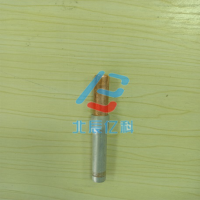 |
| Figure 1 Copper and aluminum pipes |
2. Experimental environment
The test platform consists of the 25KW equipment of Shenzhen Beichen Yike Technology Co., Ltd. as the main platform. The extension uses 3 sets of magnetic core extensions, plus copper and aluminum tubes.
 |
| Figure 2 Sensor |
3. Experimental steps
1. Build the test platform according to the schematic diagram to ensure the safe and reliable connection of the circuit;
2. Ensure that the cooling circulating water is normal;
3. Make the required sensors;
4. Prepare the tooling and fixture, use the tooling and fixture to compress the workpiece, and use the induction coil to perform induction heating test on the workpiece.
4. Experimental data
4.1 Product 1
In this welding experiment on copper and aluminum pipes, the inductors are shown in Figure 2, and the solder is special flux-cored solder from Beichen Yike. Using Φ2.0*20mm double-circle welding ring, the welding effect diagram is as follows:
 |
| Figure 3 Welding effect diagram |
4.2 Product 2
In this welding experiment on copper and aluminum pipes, the sensor used the sensor shown in Figure 2, and the solder Beichen Yike special flux-cored solder. Using Φ2.0*16mm single-turn welding ring, the welding effect diagram is as follows:
 |
| Figure 4 Welding effect diagram |
5. Experimental analysis and conclusion
This experiment mainly carried out welding experiments on copper and aluminum tubes, and the solder used Beichen Yike special flux-cored solder.
Experimental results: Beichen Yike special solder is used for copper-aluminum welding. It is preliminarily determined that copper-aluminum can be welded, and the surface of the workpiece is filled with sufficient solder. Product 1 has a penetration depth of 7-8mm (above 70%), and product 1 has a penetration depth of 4.5-5mm (above 90%). Yes, but the surface of the workpiece is not smooth.
 Scan and follow!