

Technology Exchange
Technology ExchangePosition:Home>>NEWS>>Technology Exchange
Induction brazing of evaporator lead-out tube
Abstract:
This article proposes a high-frequency induction brazing method for the
evaporator lead-out tube in automobile air-conditioning accessories. In
addition, the process flow and operation method are proposed to improve
the existing production process and solve the problem that the induction
brazing of the evaporator lead tube is difficult.
Key words: high frequency induction brazing, evaporator outlet tube, aluminum high frequency induction brazing process
1. Overview of high-frequency induction brazing of the evaporator outlet tube
1.1 Overview of high frequency induction brazing
High-frequency induction brazing: The welding seam is heated to the
melting temperature of the alloy solder by heating, but the metal being
welded at this time still has not reached the melting temperature, and
the low melting point alloy bonds the two metals together through strong
surface tension After cooling, a solid weld is formed. The parts of the
same or different materials can be welded together, the material saving
effect is remarkable, and various needs can be met. Suitable for
welding various magnetic materials such as steel, copper, aluminum,
nickel, and special alloys. High-frequency local welding has high
strength, no deformation, and comprehensive mechanical properties are
better than other welding.
Shoulder brazing is one of many
brazing methods. It does not use heat radiation to heat the metal, but
uses the principle of electromagnetic induction to make the metal itself
generate heat. This heating method has high energy utilization rate and
rapid heating, and only uses electric energy, and has the
characteristics of low energy consumption, low pollution, and low harm.
1.2 Overview of the evaporator outlet pipe
The evaporator outlet pipe is a very common important functional accessory in automobile air-conditioning pipelines.
 |
| Figure 1 Outlet tube of evaporator |
2. Material welding performance analysis
Compared with other alloys, aluminum alloy is more difficult to braze, the main reasons are:
(1)
It is easy to form an extremely dense oxide film on the surface. The
nature of this oxide film is very stable, covering the surface of the
workpiece will hinder the wetting of the solder on the surface of the
workpiece, thereby affecting the quality of brazing. The melting point
of the oxide film on the surface of aluminum alloy is very high, and at
the brazing temperature of 500~600℃, the thickness of the oxide film
will sharply increase to about 20~40 times that at room temperature,
which seriously hinders the wetting and wetting of the brazing filler
metal and the base material. Combine. This is also the main reason why
it is difficult to repair aluminum alloy after brazing once;
(2)
When brazing aluminum alloy, since the melting point of the brazing
filler metal is not much different from that of the aluminum alloy, the
brazing temperature must be strictly controlled, otherwise it will
easily cause the workpiece to burn out.
It should be pointed out that
the brazing performance of the material cannot be changed, but we can
improve the welding quality by improving the brazing process.
3. Description of process status
At present, the main method to solve the welding of automobile
air-conditioning pipes is through artificial flame welding, but
artificial flame welding has disadvantages such as high temperature,
glare, noise, smoke, and high-intensity work.
 |  |
| Figure 2 Tunnel brazing furnace | Figure 3 Artificial flame brazing |
4. System architecture description
The system consists of seven parts: chiller, portable induction power
supply, extension, output unit, positioning tooling, auxiliary parts,
and cleaning after welding.
 |
| Figure 4 System architecture description |
The basic working unit includes a chiller (mainly used for circulating
cooling for the output unit and the main extension of the induction
heating power supply), and the induction heating power supply, extension
and output unit are a mature subsystem. When large-scale mass
production is carried out, positioning tooling must be used, otherwise
it will not be able to meet the production requirements. Therefore, as
long as there is a chiller, an induction power supply system, and a
positioning tool, the production work can be carried out. For higher
requirements, a complete set of high-frequency induction brazing
solutions can be realized with the help of auxiliary equipment, such as
infrared thermometers, post-welding cleaning devices, such as ultrasonic
cleaning machines.
 |
| Figure 5 Equivalent physical diagram of the system framework |
5. Process flow
Welding power source selection-sensor selection-solder flux
selection-tooling positioning design-accessory selection-welding
parameter determination-cleaning after welding
5.1 Selection of welding power source
According to the pipe diameter and the size of the pressure plate in
the single pipe in the picture, we choose the dedicated all-digital
L-MDIH-40 model as the welding power source.
 |
| Figure 6 All-digital L-MDIH-40 welding power source |
5.2 Sensor selection
Since most of the evaporator outlet pipes are bent pipes, it is
inconvenient to use a closed inductor to clamp, so an open inductor is
used.
 |
| Figure 7 Welding output terminal |
5.3 Selection of solder additives
The aluminum evaporator outlet tube is determined by our company's
process department to use flux-cored welding wire or self-brazing wire.
 |
| Figure 8 Solder additives |
5.4 Tooling positioning design
Induction heating welding is to place the welding part of the workpiece
in an induction magnetic field for heating. The strength of the
magnetic field in each part of the magnetic field is different, and
there is a high requirement for the positioning repeatability of the
workpiece. Therefore, it is necessary to design the corresponding
tooling according to the specifications of each workpiece and the
welding process at the same time. Our company can provide induction
brazing tooling design services.
5.5 Auxiliary selection
In high frequency induction welding, the induction heating power supply
needs to be cooled, and an industrial chiller of corresponding
specifications is required. When the customer uses the infrared mode and
performs temperature monitoring in real time, a digital infrared
thermometer needs to be installed. Our company's infrared temperature
measurement When the instrument and the power supply work together, the
temperature control accuracy can reach up to 1℃. Our company can provide
water chillers, high-frequency brazing customized infrared
thermometers.
 |  |
| Figure 9 Industrial chiller | Figure 10 Digital infrared thermometer |
5.6 Determination of welding parameters
After our long-term high-frequency brazing research and a lot of
customer experience, we choose the automatic heating mode in this model.
The heating current of the automatic heating mode is divided into five
sections. In this process, the characteristics of aluminum metal vary
with the temperature When the resistance increases, the Joule effect
causes the heating rate to increase during the heating process. This is
inconsistent with the welding process summarized by our research.
Therefore, we use the method of gradual decrease in current to heat the
welding part. In this way, the temperature of the welding part can be
increased under the premise of uniform heating, and the workpiece can be
prevented from overburning in the high temperature section. Finally, in
order to ensure the integrity of the welding process, we set a small
current for heat preservation afterwards to ensure that it reaches the
penetration standard and has no porosity. And other technological
standards.
 |  |
| Figure 11 Heating parameter setting | Figure 12 Display of operating parameters |
5.7 Cleaning after welding
After the soldering is completed, the surface of the solder
accumulation area needs to have auxiliary residues, which need to be
cleaned. The current environmentally friendly way is to use ultrasonic
cleaning. Our company can provide ultrasonic cleaning machine after high
frequency welding.
 |  |
| Figure 13 Fully automatic ultrasonic cleaning machine | Figure 14 Industrial single tank ultrasonic cleaning machine |
6. Operation steps
Surface preparation: remove the oxide film and oil stains on the surface of the workpiece
Positioning
of the workpiece: the workpiece is positioned, supported, and fixed to
ensure that the relative position of the workpiece and the sensor is
unchanged during mass production, and the brazing filler metal is made
into a ring and added to the part to be welded.
Heating process:
using the previously set parameters, the operator only needs to press
the start button, the equipment will automatically execute the
previously set parameters to accurately weld the workpiece, and stop
heating after the welding is completed.
Post-brazing treatment: directly put the workpiece in the water or clean it with other chemicals
7. Energy consumption comparison
Table 1 Comparison of energy consumption between flame brazing and induction brazing
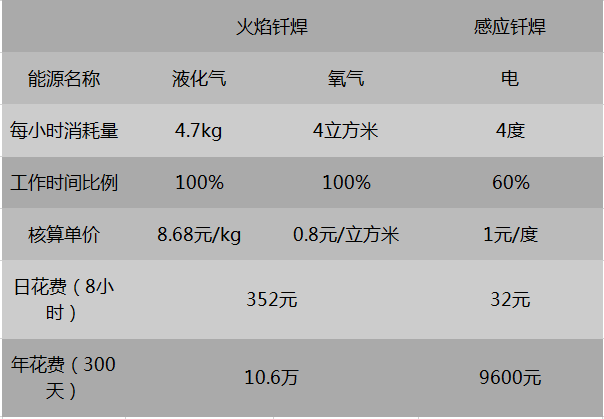
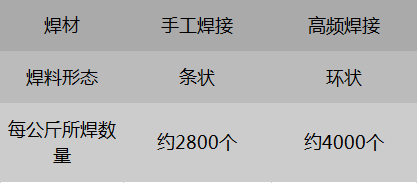
Table 2 Comparison of solder consumption between manual welding and induction brazing
(1)
The welding process is equipped to reduce the dependence on manual
technology. Ordinary operators can replace the certified flame welders,
which reduces the burden of safety and annual certification of the
company.
(2) The advantages of induction brazing are not obvious
when there are small workpieces and fewer pipelines. However, in the
induction brazing welding process, the equipment is automatically welded
without manual operation, and the welding time can be used to operate
another equipment, so that one person can operate two welding machines
at the same time. This can further improve product quality.
(3) According to the data in the above figure, the annual energy saving can be 10.6-9600=100,000 yuan
8. Summary
This article describes the 7 aspects of high-frequency induction
brazing technology, material welding performance analysis, process
status description, process flow, operation method, and energy
consumption comparison of the evaporator outlet tube in the automobile
air-conditioning pipeline. The problem of induction brazing proposes a
solution based on all-digital induction heating technology, covering all
links before, during and after welding. And given detailed and
effective data to prove that high-frequency induction brazing is
superior to flame brazing in terms of environmental protection, energy
consumption, and welding material consumption.
 Scan and follow!